Do You Really Need Agentic AI? A Practical Decision Framework
Agentic AI is everywhere right now. Everyone wants to build an “agentic AI system.” But before you start coding your first agent, it is worth asking a simpler question:
Do you really need agentic AI?
Generally the questions people ask are: How much autonomy does the problem require? Do I need Agentic AI, MCP, Skill, or a Workflow? but a better question is : Does this problem need autonomy, or can I solve it with a simpler pattern?
Not every AI-enabled system needs autonomy, planning, memory, tool use, or multi-step reasoning. Sometimes the right solution could be a prompt, a workflow, a RAG pattern, an API integration, an MCP server, or a single-purpose skill.
In this blog, I will share a framework for leaders, architects, and engineers to decide when agentic AI is the right fit and when a simpler design is safer, cheaper, and easier to operate.
before we move to the decision framework, let’s do a quick revision :
- Agentic AI: Use agentic AI when the system needs to plan, choose actions, use tools, observe results, and adapt.
- MCP: An integration protocol for exposing tools. Use MCP when the main challenge is connecting tools, data, and context.
- Skill: a bounded capability or action; Use a skill when the task is narrow.
- Workflow : a predefined sequence of steps. Use a workflow when the steps are known.
- RAG: Use RAG when the main challenge is retrieving knowledge.
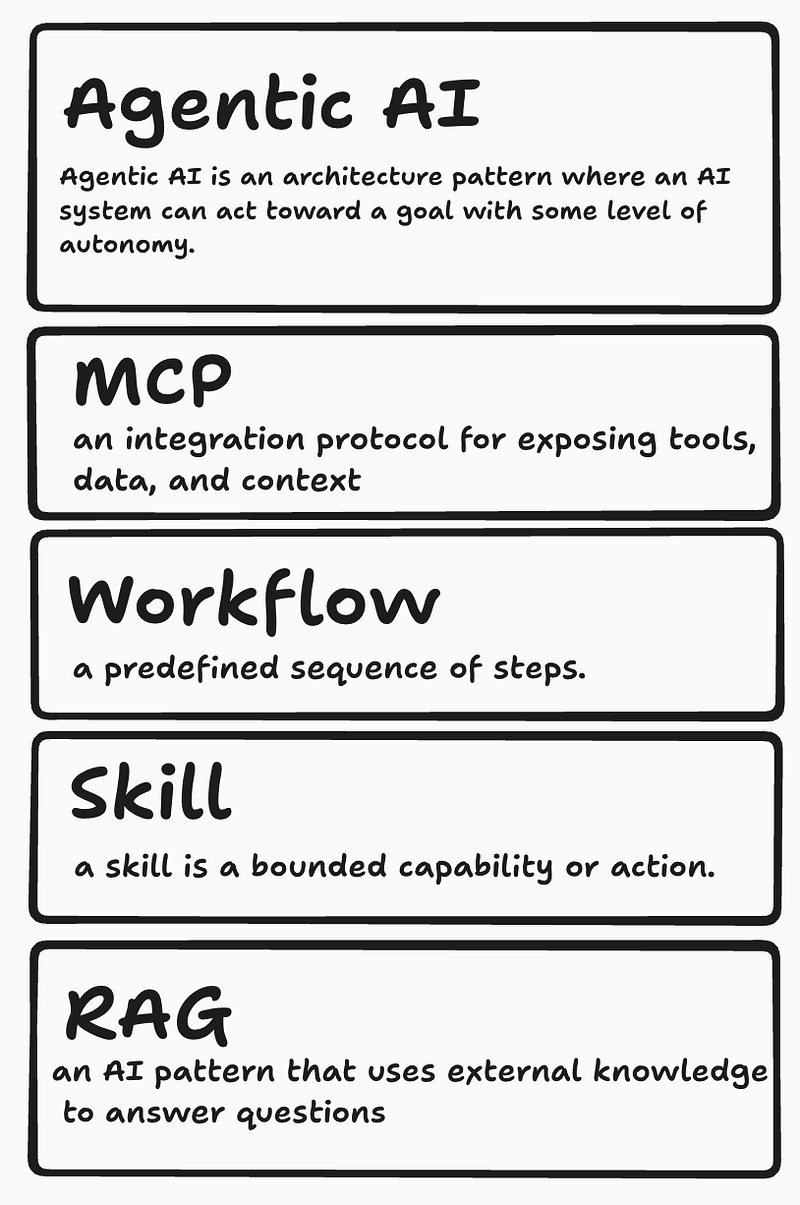
Now, we know what all the terms are. Below is a way to think about which one to use and when
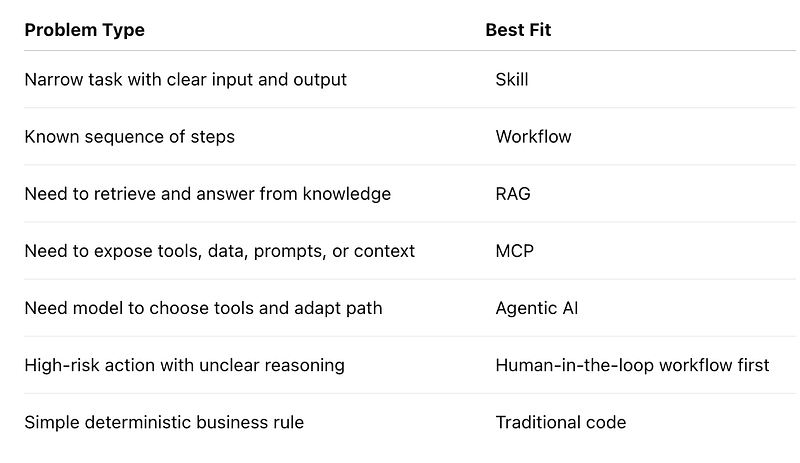
Decision Framework
- Can the task be solved with rules, workflow, RAG, or a single tool call
- Does the problem require multi-step reasoning?
- Does the path change depending on intermediate results?
- Does the system need to choose between multiple tools?
- Does it need memory or context across steps?
- Does it need to recover from failures?
- What happens if the agent makes the wrong decision?
- How will you evaluate, monitor, and control the system?
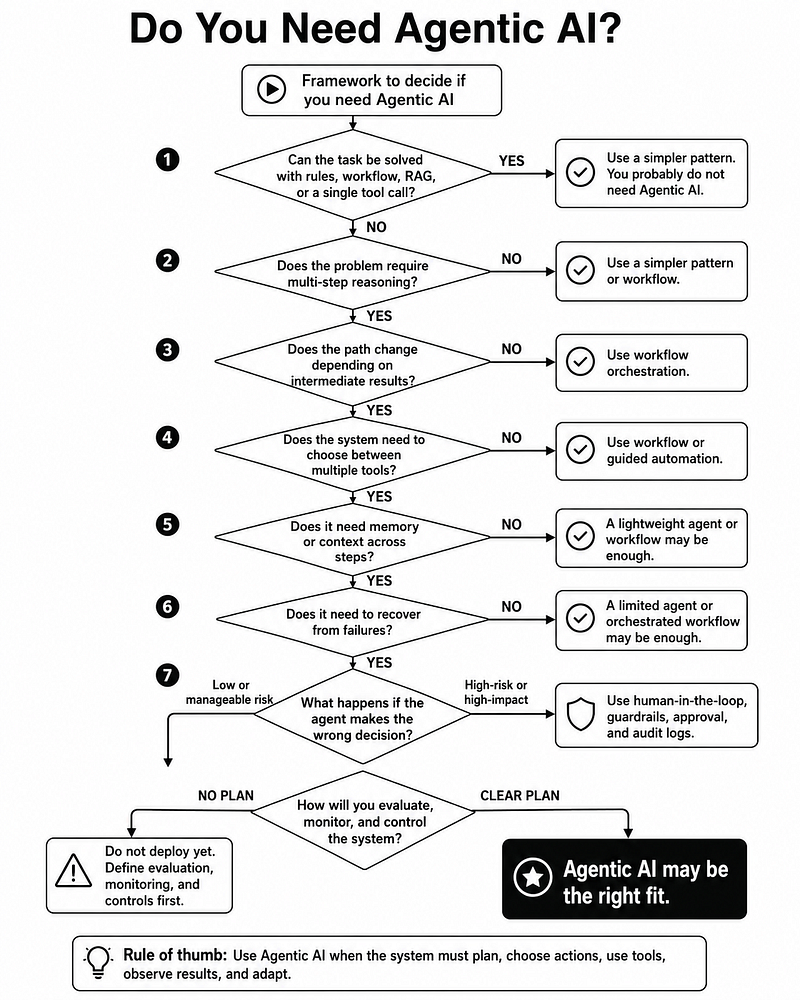
When You Probably Do Need Agentic AI
Use agentic AI when the task is dynamic, goal-oriented, multi-step, and requires tool selection, adaptation, or decision-making under uncertainty.
Examples: Investigating an incident across multiple systems, Planning and executing a complex customer support resolution, Researching, comparing, and summarizing information from multiple sources, Coordinating actions across several enterprise tools
When You Probably Do Not Need Agentic AI
Avoid agentic AI when the task is predictable, linear, high-volume, compliance-heavy, or easily solved with simpler patterns.
Examples: Extracting fields from invoices, Answering FAQs from a knowledge base, Running a fixed approval workflow, Calling one API based on user input, Summarizing a single document
Architecture Considerations Before You Build an Agent
- Tool Access: What tools can the agent use? Can it read only, or can it write? Can it send emails, update tickets, change records, deploy code, or trigger workflows? Start with the least privilege possible.
- Human Approval: Which actions require human approval? A good pattern is to allow the agent to recommend actions before allowing it to execute actions.
- Observability: Can you see what the agent planned, what tools it used, what data it accessed, and why it made a decision? If you cannot observe it, you cannot operate it safely.
- Evaluation: How will you test the agent? You need test cases for successful paths, edge cases, tool failures, bad inputs, ambiguous requests, and unsafe actions.
- Cost and Latency: Agentic systems often require multiple model calls and tool calls. This can increase cost and latency. Use agentic AI when the value of better task completion justifies the extra complexity.
- Failure Modes: What happens when the agent gets stuck? What happens when a tool fails? What happens when two data sources disagree? What happens when the agent is confident but wrong? Design for failure from the beginning.
Thank you for reading this. If you like this, then please share in your network . You can contact me at X or Linkedln