From One Agent to Many: Understanding Multi-Agent Agentic AI
In the last blog, we learned about “Introduction to Agentic AI”. Today, we are going to have a deep dive of Multi Agent Agentic AI.
- What is multi agent Agentic AI system
- When you need multi agent
- Core components of a multi-agent system
- Challenges
- Example: Incident triage multi-agent system
What is multi agent agentic AI system
A multi-agent AI system is an agentic system where multiple specialized agents collaborate, coordinate, or hand off tasks to accomplish a shared goal.
For example, let’s consider an incident triage system. A multi-agent system might divide that work across specialized agents: one checks alerts, one investigates logs, one reviews recent deployments, one searches runbooks, one assesses severity, and one prepares the final recommendation for the on-call engineer.
multi-agent does not simply mean “many prompts” or “many LLM calls.” It means agents may have different roles, tools, context, responsibilities, and decision boundaries.
In a traditional incident workflow, when an alert fires, an on-call engineer has to acknowledge the alert, investigate the issue, check logs and metrics, review recent changes, identify the likely root cause, and decide what action to take.
With agentic AI, some of this investigation can be supported or automated. Instead of one general-purpose agent doing everything, we can introduce multiple specialized agents. For eg:
- An alert analysis agent reviews the alert and identifies the affected service.
- A log analysis agent checks recent logs for errors or anomalies.
- A metrics agent reviews dashboards and system health signals.
- A deployment agent checks recent releases or configuration changes.
- A runbook agent searches internal documentation for known fixes.
- A summary agent combines the findings and recommends the next step.
The goal is not to replace the engineer. The goal is to reduce manual investigation time, share relevant context quickly, and help the engineer make a better decision faster.
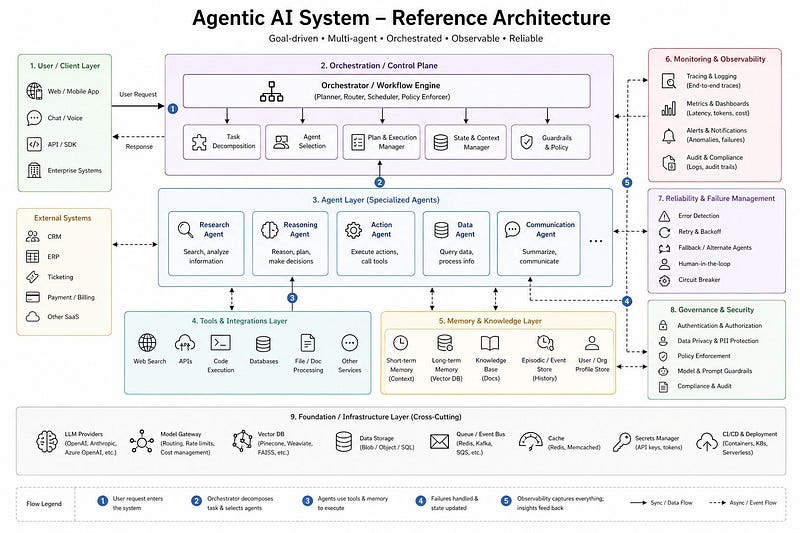
When you need multi agent
One of the first design decisions when building an agentic AI system is whether to use a single agent or a multi-agent system.
A single agent is often enough when the task is simple, linear, and can be completed using one set of instructions and tools.
A multi-agent system is useful when the goal requires multiple types of expertise, parallel investigation, independent verification, or clear separation of responsibilities.
You should consider a multi-agent approach when:
-
The task can be broken into distinct subtasks.
-
Different subtasks require different tools or data sources.
-
Multiple investigations can happen in parallel.
-
You need one agent to verify or critique another agent’s output.
-
The workflow involves handoffs between different responsibilities.
-
The final answer requires combining evidence from several sources.
PS: check the framework to decide you need Agentic AI system or not
In the incident triage example, using multiple agents makes sense because troubleshooting usually requires looking at different signals: alerts, logs, metrics, deployments, runbooks, and historical incidents. Each of these can be handled by a specialized agent and then combined into one final triage summary.
Core components of a multi-agent system
A multi-agent system is more than just multiple agents running together. It needs a clear structure so that agents know what they are responsible for, how they communicate, and how the final outcome is produced.
- Agents: Agents are the main building blocks of the system. Each agent has a specific role, goal, and responsibility. Eg, in an incident triage system, we may have: An alert analysis agent, A log analysis agent , A metrics analysis agent, A deployment review agent, A runbook search agent, A summarization agent. Each agent focuses on a specific part of the problem instead of one large agent trying to do everything
- Tools: Tools allow agents to interact with external systems. Without tools, an agent can only reason based on the information given in the prompt. With tools, agents can search documents, query databases, call APIs, read logs, create tickets, or trigger workflows. Eg incident triage system, tools may include Log search tools, Metrics dashboards, Alerting systems, Incident management platforms, Deployment history, Internal documentation, Ticketing systems
- Memory: Memory helps agents retain useful context. It can include previous user instructions, past actions, historical incidents, known issues, or previous decisions. Memory can be short-term or long-term:
a.Short-term memory stores context during the current task.
b. Long-term memory stores useful information across multiple tasks or sessions.
In an incident triage system, memory can help the system remember that a similar alert happened last week, what caused it, and how it was resolved. However, memory must be handled carefully. Incorrect or outdated memory can lead to wrong recommendations.
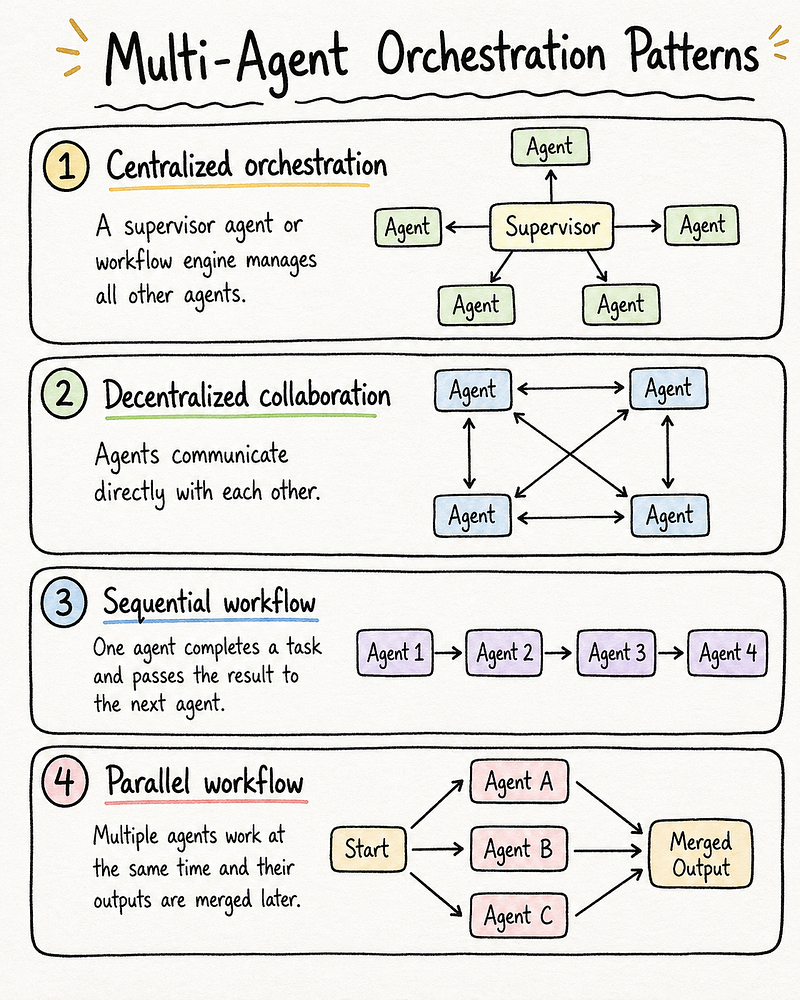
4. Orchestrator: The orchestrator controls the overall workflow. It decides which agent should run, when it should run, and how the outputs from different agents should be combined. There are different orchestration patterns:
- Centralized orchestration: A supervisor agent or workflow engine manages all other agents.
- Decentralized collaboration: Agents communicate directly with each other.
- Sequential workflow: One agent completes a task and passes the result to the next agent.
- Parallel workflow: Multiple agents work at the same time and their outputs are merged later.
AI made; Human prompted
5. Evaluation & Observability: Multi-agent systems can become complex quickly. Observability helps us understand what happened inside the system. A production-ready multi-agent system should track: Which agents ran, what tools they used, what data they accessed, what decisions they made, how long each step took, where failures happened, whether the final recommendation was correct
This is important for debugging, improving accuracy, reducing false positives, and building trust with users
6. Communication Protocol: Agents need a clear way to communicate. This includes what information they pass to each other, in what format, and at what stage of the workflow. For example, a log analysis agent should not simply say, “I found some errors.” A better output would include: the service name, error type, timestamp, frequency, related request IDs, confidence level, supporting evidence
Structured communication makes the system easier to debug and evaluate.
7. Shared State: Shared state is the common workspace where agents store intermediate findings. It allows different agents to contribute to the same investigation. For example: alert details, affected service, suspected root cause, evidence collected, confidence score, recommended next action
Shared state prevents agents from working in isolation and helps the system maintain a consistent view of the task.
Challenges of Agentic AI
- More Complexity: Agentic systems are more complex than simple AI applications due to involvement of tools, and many layers the system becomes harder to design, test, and debug.
- Risk of Wrong Actions: If the agents will have access of “high-impact” tools and start taking decisions eg: closing an incident incorrectly can create real production risk. This is why high-impact actions should require human approval.
- Hallucination and Incorrect Reasoning: Agents can still make incorrect assumptions or generate wrong explanations. Tool usage reduces some risk because agents can check real data, but it does not eliminate the problem completely.
- False Positives: An agent may detect an issue where there is no real problem. In incident management, this can create unnecessary alerts, wasted investigation time, or alert fatigue.
- Conflicting Agent Outputs: In a multi-agent system, different agents may reach different conclusions. For example, a metrics agent may say the system is healthy, while a log analysis agent may report errors. The system needs a way to compare evidence, handle conflicts, and escalate uncertainty.
- Security and Access Control: Agents should not have unlimited access to systems and data. Each agent should only access what it needs for its role. Sensitive actions should be logged, permissioned, and reviewed.
- Evaluation Is Harder: Traditional software can often be tested with expected inputs and outputs. Agentic AI is harder to evaluate because the path may change depending on the model’s reasoning, tool results, and intermediate decisions. Teams need strong evaluation datasets, test scenarios, human review, and production monitoring.
- Cost and Latency: Multi-agent systems may require multiple model calls, tool calls, and coordination steps. This can increase cost and response time. For simple tasks, a single agent or deterministic workflow may be more efficient.
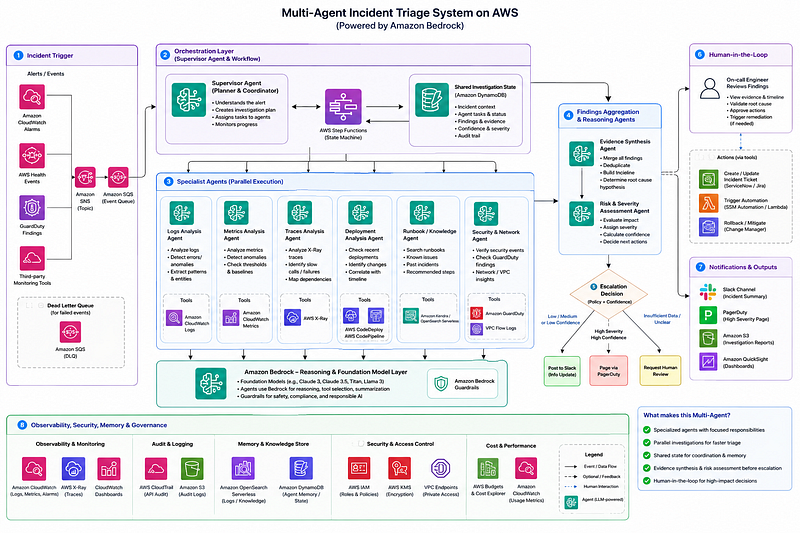
Agentic AI for Incident Triage
This is how the Incident triage architecture will look with multi-agent agentic AI
AI made; Human prompted
Thank you for reading this. If you like this, then please share in your network . You can contact me at X or Linkedln